
Network
Stream SCADA can be deployed in many ways. And it supports various Client/Server architectures. This section address the needed settings for the different possible scenarios.
From Stream Explorer, select Network.
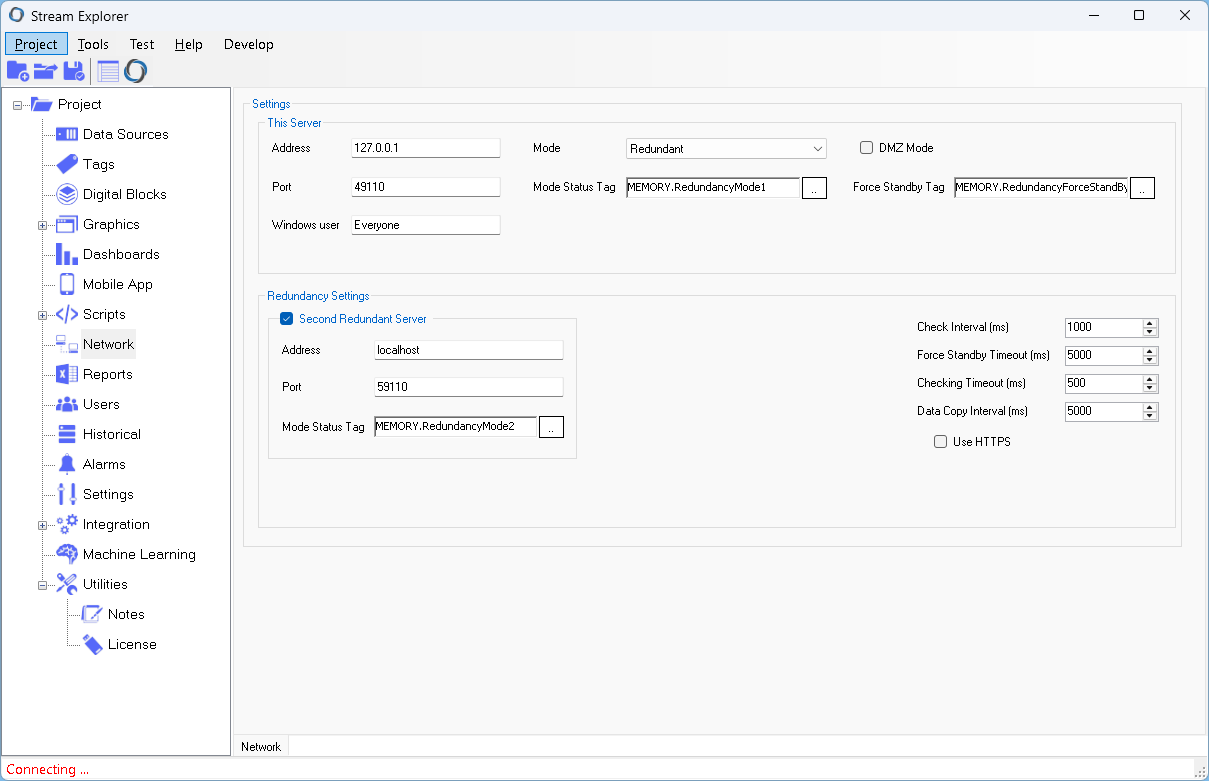
Fields Description
|
Group / Field |
Purpose |
Accepted values & caveats |
|
This Server |
|
|
|
Address |
IP or DNS name the service binds to on this machine. |
Any valid local NIC address. |
|
Port |
TCP port the embedded web/API listener starts on. |
Must be free at startup. Default 49110. |
|
Windows user |
Windows account under which the service will run. |
Everyone is Default |
|
Mode |
Deployment mode: Single or Redundant. |
Selecting Redundant unlocks the Redundancy Settings panel. |
|
Mode Status Tag |
Tag whose value represents this server’s Mode |
Integer/Real. -1 = Unknown, 0 = Starting, 1 = Active, 2 = Standby. |
|
Force Standby Tag |
Write‑only tag that, when set to 1, forces this server into standby until the partner confirms activation. |
Integer/Real. Auto‑reset to 0 after a successful switchover. |
|
DMZ Mode |
Using this mode, this server can't write data to server. Use this mode when it's required to avail data securely without the ability to change data. For example, remote clients and 3rd party systems. |
Leave unchecked unless you must expose the listener outside the LAN. |
|
Redundancy Settings |
|
|
|
Second Redundant Server |
Master enable for redundancy. |
|
|
Address |
IP or DNS name of the partner server. |
Must be routable from this host. |
|
Port |
Partner’s listener port. |
Default 80810. |
|
Mode Status Tag |
Tag that belongs to the partner server and reflects its role. |
Values: ‑1 = Unknown, 0 = Starting, 1 = Active, 2 = Stand‑by. |
|
Check Interval (ms) |
How often this node pings the partner to read its status. |
Default 1000 ms. Lower = faster fail‑over but higher network utilization. |
|
Checking Timeout (ms) |
HTTP‑client timeout for the status check call and data update calls. |
Must be <= Check Interval. Default 1000 ms. |
|
Data Copy Interval (ms) |
When this server is Standby, it pulls tag values & alarms from the partner at this interval. |
Default 5000 ms. |
|
Force Standby Timeout (ms) |
When this server is forced to standby, it waits until timeout passes or until the redundant server is active then this server continues its normal redundancy check operation. |
|
|
Use HTTPS |
Forces the status‑check and data‑copy traffic over TLS. |
|
Below are several scenarios:
Scenario (1)
- Scenario description: Single machine running both as server and operator work station.
- Required Settings:
Mode: Single
Address: localhost
Port: 49110 (Only change it when this port is used by another application).
Windows User: Everyone
Scenario (2)
- Scenario description: Two machines; one is the server and the other is the client.
- Required Settings:
Mode: Single
Address: Server IP address (Example: 192.168.1.1)
Port: 49110 (Only change it when this port is used by another application).
Windows User: Everyone
Scenario (3)
- Scenario description: Two redundant servers on two redundant machines.
- How it works:
1. Boot‑up role decision
- On start‑up each server reads the partner’s Mode Status Tag:
- If the partner is Active (1) → this server becomes Standby (2).
- Otherwise, this node promotes itself to Active (1).
2. Normal operation loop
- Every Check Interval the standby server queries the partner:
- If partner status returns Unknown (‑1) or Standby (2), promote to Active.
- Else remain standby and block all external tag writes.
3. Data synchronization (standby only)
- A separate thread copies tag snapshots and current alarms every Data Copy Interval so the standby is hot‑ready.
4. Forced switchover
- Writing 1 to Force Standby Tag on the active server:
- Node demotes itself to standby.
- Waits up to the internal Force Standby Timeout (default to 5000 ms).
- As soon as the partner declares Active the tag auto‑resets to 0.