
Alarms
Alarm definitions usually should have different behaviors based on their priorities. this section shows you how to view or edit it.
From Stream Explorer, select Alarms
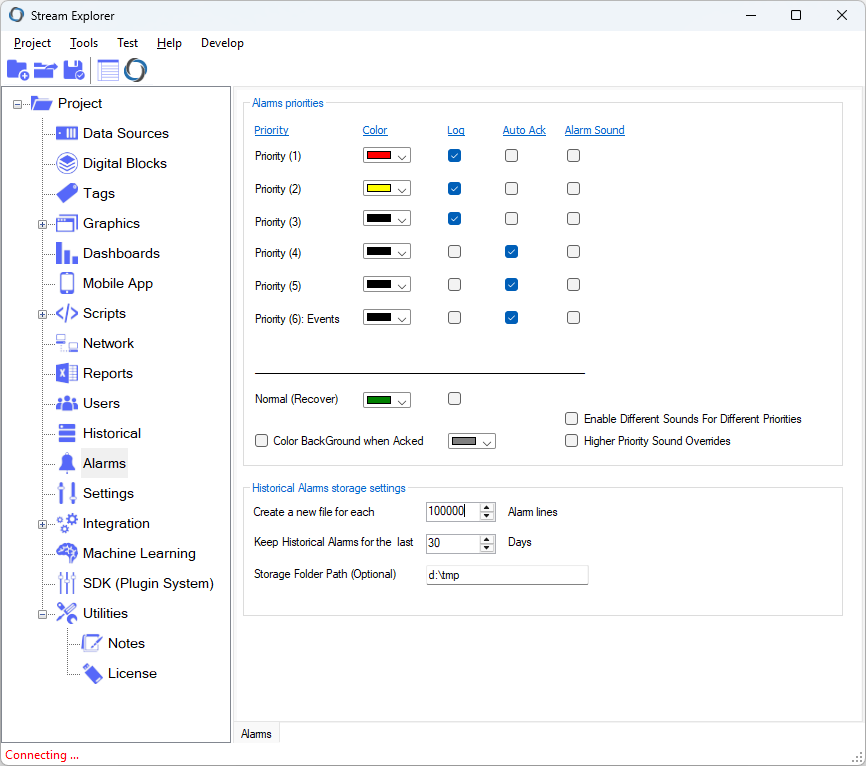
Each configured alarm should have a priority assigned to the alarm. This alarm priority is assigned from the Tag Editor / Alarms tab as shown in the below screen shot. For more info about the details of alarm settings, refer to Tags / Alarms Configuration.
Alarm Priorities
Alarm priority defines the following behaviors:
- Color: The text color of the alarm line in the Alarm Viewer.
- Log: Enable or disable logging the alarm in the historical alarms.
- Auto Ack: Sets the option of auto-acknowledging of the alarm (sometimes called Self-acknowledge). When this option is set, the alarm line will be cleared from the alarm viewer once the alarm state is cleared without the need of the operator action (i.e. hitting Acknowledge button).
- Alarm Sound: When selected for a certain priority, alarm sound will play when there's any new alarm that has this specific priority.
- Normal (Recover): When the alarm is cleared, the alarm line can have a special color (green as default). You can also wither to log or not.
Note: Priority 6 is reserved to "Events". This is useful for filtering the alarm viewer to this category only. Refer to Alarm Viewer / Filter Tab for more info.
Alarm Sound Options
Alarm priority defines the following behaviors:
- Enable Different Sounds For Different Priorities
Lets you assign a separate WAV file to each alarm priority.
Each wav file’s name must exactly match the priority number — “1.wav” for Priority 1, “2.wav” for Priority 2, and so on. When this box is checked the system looks for those files in your configured Alarm Sound Folder (\Configuration\AlarmSounds).
• If the file exists, its sound loops until the alarm is cleared.
• If the file is missing, or this box is unchecked, the default built-in tone plays instead.
- Higher Priority Sound Overrides
Keeps a critical (lower-number) alarm tone from being interrupted by less-urgent (higher-number) ones.
• While Priority 1 is sounding, requests for Priority 2–6 are ignored until the higher-priority alarm is acknowledged or returns to normal.
• Has no audible effect when Enable Different Sounds For Different Priorities is unchecked, because all priorities share the same tone in that mode.
Historical Alarms storage settings
- Create a new file for each: [Default 100000] Alarm lines
Controls how many alarm records are stored in each file before a new file is created.
Smaller values create more files but keep each file smaller for faster queries.
Larger values create fewer files but may slow down queries on very large files.
- Recommended: 50,000 - 200,000.
- Each 100,000 records ≈ 50-70 MB.
- Keep Historical Alarms for the last: [Default 30] Days
Alarm records older than this number of days are automatically deleted during cleanup. Files that contain only expired records are deleted entirely.
Set higher values to retain more history (requires more disk space).
- Run Cleanup Every: [Default 24] Hours
How often the system checks for and deletes expired alarm records.
Cleanup also runs automatically when the server starts.
- Recommended: 12-48 hours
- Storage Folder Path (Optional):
Custom folder path where alarm history files are stored. Leave empty to use the default project Historical folder.
Use this to store alarms on a separate drive or network location.
The folder will be created automatically if it doesn't exist.
Note: Files are stored in an "Alarms" subfolder within this path.